

TWA
GREAT DIVIDE 2.0 - analog synth octaver
GREAT DIVIDE 2.0 - analog synth octaver
Couldn't load pickup availability
IN STOCK. Please allow up to 10 business days for us to build and test your Great Divide.
Once your Great Divide ships, you'll receive your tracking information.
|
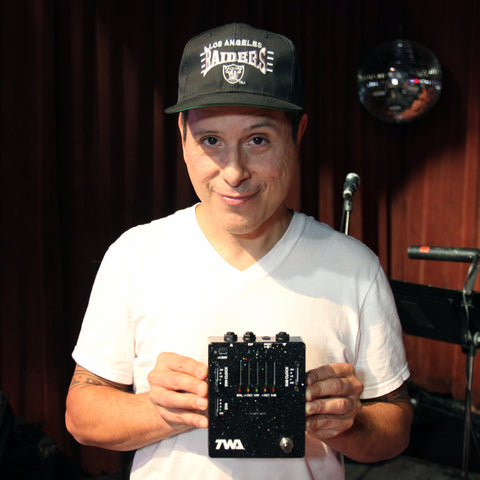
| Juan Alderete (Mars Volta, Racer X, Marilyn Manson) and his TWA GD-02 Great Divide. |
About the Great Divide 2.0:
It's been a long road for the overhaul of this amazing pedal. We are proud to announce that the arrival of the Great Divide 2.0.
We appreciate your patience while we reconstructed this pedal to bring you 2.0...
Great Divide, Mk II
Three years, two cease & desist letters, one trip to Buffalo, tens of thousands of dollars, two redesigns and a few nervous breakdowns later; the Great Divide is finally finished and ready to be unleashed on the world!
The Great Divide Mk. II combines classic analog octave division with proprietary Synth technology to create one of the best-sounding, most versatile octave units ever made!
The Great Divide features five independent voices that can be continuously blended for a limitless array of sounds, from classic stompbox octave division to multi-layered, supersonic Synth mayhem!
The Great Divide is 100% analog – the circuit tracks incoming audio and subdivides the waveforms to create lower notes at varying intervals. The lower voices are monophonic, but can sometimes be coaxed into tracking double-stops (say please!). The GD’s Upper Octave voice is a form of harmonic distortion that can track polyphonically with eerie precision and often unpredictable results (ring mod, anyone?).
By blending voices at various levels, an absolutely limitless variety of super-sick, super-FAT, super-sexy Synth and octave sounds can be created and deployed to beat your audiences’ booty into submission.
Make your guitar sound like a Bass; an Arp; a Harp; a Hammond – whatever. Make your Bass sound like a Moog; a Guitar; a Moog Guitar or an asteroid hitting the Earth’s atmosphere – you get the idea…
For even more tonal options, patch in an external pedal via the TRS effects loop and control it with the Great Divide! OR, use an expression pedal to control the GD’s output level for gorgeous Synth pad volume swells and other assorted mayhem.
The Great Divide features TWA’s proprietary S3™ “Shortest Send Switching™” - a form of relay-based True Bypass switching that provides the most transparent bypass sound available. S3™ switching also automatically reverts the pedal to bypass mode if power is lost.
WORDS SIMPLY CANNOT DESCRIBE THIS PEDAL – Watch the videos and see for yourself, but please note that these samples are just the tip of a Titanic-tanking iceberg of tone. Now –GO GET SOME!!!
CONTROLS
The Great Divide Mk. II features the following controls:
- Dry Level Fader
- -1 Octave Level Fader
- +1 Octave Level Fader
- +1 Octave Envelope Switch (sort of like Synth resonance, or maybe a cosmic death-ray)
- SUB Level Fader & Switch with 4 Selectable voices ( -1, -1.5, -2 or -2.6)
- SYN Level Fader & Clock with 5 Selectable Voices (0, -1, -1.5, -2, -2.6)
- SYN waveform switch w/4 options (Saw/Pulse, Chopped Saw/Pulse, Square, Modulated Square)
- Cross-modulation option for -1 OCT (tracks SUB clock)
- Raw clock option for SUB voice (think MASSIVE, vulgar square wave)
- 12 Internal Trimmers to control various sound parameters (Tweaky-Tweak)
- External Effects Loop to patch in other effects (AWWWW Yeah!)
- S3™ Shortest Send Switching™ for uncolored bypass tone
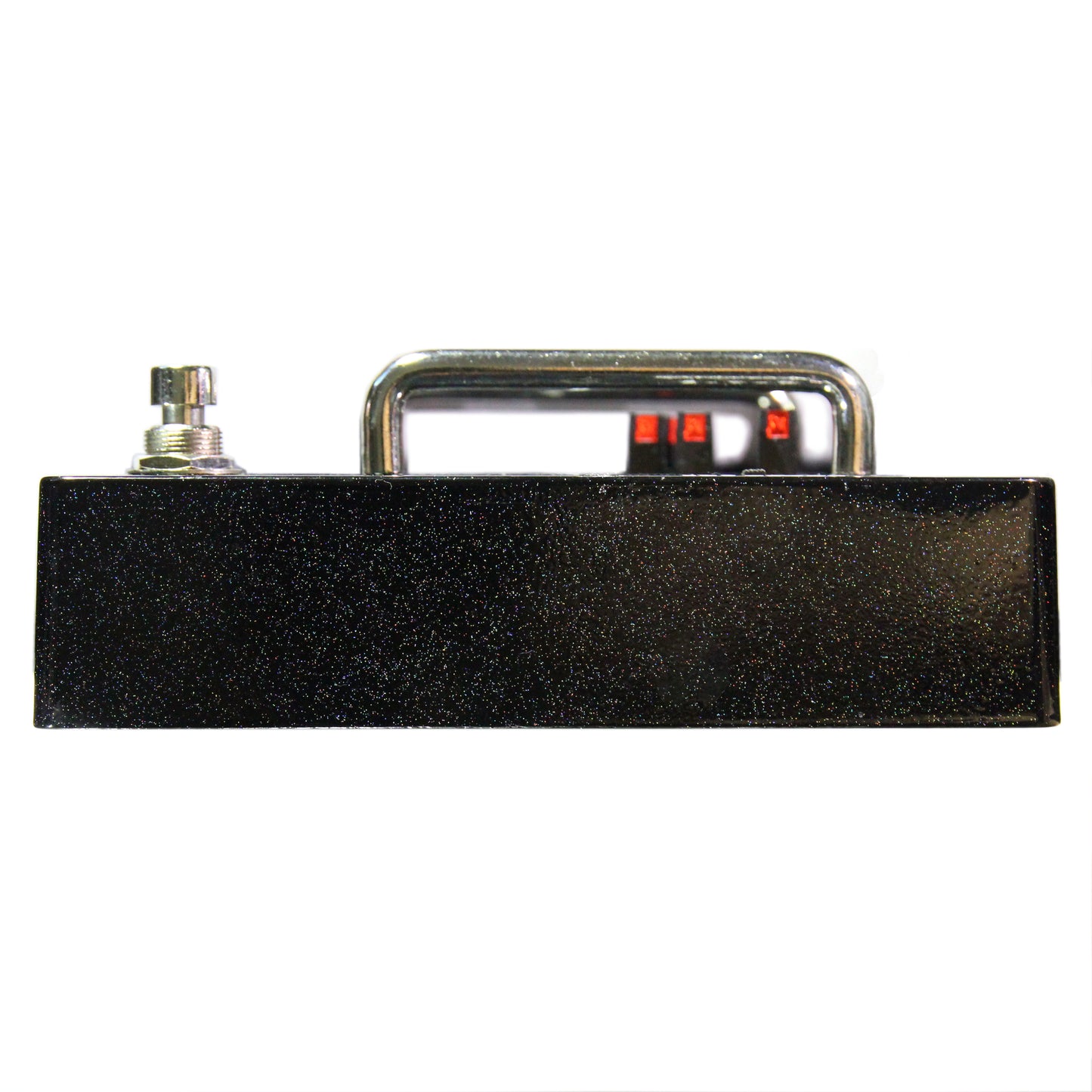
- Pedal dimensions - 5.75" L x 4.75" W x 2" T
GD Mk. I vs. GD Mk. II
A lot of people have asked what the difference is between the GD Mk I and Mk II versions, and justifiably so. There was a fair degree of hubbub and hootenanny about the GD I when it originally debuted at NAMM 2011, and then – SILENCE.
Well, what happened was we got a production quote for how much it would cost to actually build them and realized that we were out of our freaking MINDS if we tried to market this pedal!
In short, it was simply not a cost-effective project to pursue, or to put it another way – how many of you would have paid $750 for an octave divider?!?
After some painful but therapeutic self-examination and a few hard decisions, we decided to make some changes to the pedal. The first thing we did was lose our beautiful TWA custom chassis (sob) – these things were ‘spensive to make, Lucy…
In addition, the chassis’ dimensions combined with the GD’s complex circuitry meant that we needed to cram FIVE PC boards into this box in order to get what we wanted. Five boards = a LOT of money to manufacture = we need a different chassis.
Finally, we decided to lose the Preset option from the Mk I – while I was personally sad to see it go, this feature really didn’t do ALL that much, but it was accounting for the lion’s share of the parts costs in the first version of the pedal. Bye bye, preset switch – until we meet again…
OK – a clean slate, so to speak. From here we selected a very run-of-the-mill, standard Hammond-style box that was easy to come by and not so pricey, and then set about redesigning the PC boards.
With the new, larger chassis we were able to reduce the number of PC’s to two, and this brought costs down dramatically. Between-board connectors are CRAZY expensive, and we were able to lose 3 sets – now that’s cutting costs.
In addition, the slightly larger space in the new chassis allowed us to actually add a few features that didn’t exist on the Mk. I version – namely, a dedicated clock with selectable intervals for the Synth voice (the Mk I SYN tracked the clock from the SUB voice). In addition, we were able to add the Cross-modulation feature for the -1 Octave as well as the LPF shut-off for the SUB voice. These three new features add dramatically to the versatility of the Mk. II's audio.
For those of you with short attention spans, let’s review:
REMOVED – Custom Chassis
Preset toggle function
ADDED – Dedicated Clock for SYN voice with 0, -1, -1.5, -2, -2.6 options
Cross-modulation option for -1 OCT
LPF shut-off switch for SUB voice
In short, we were able to ADD more features while bringing the cost DOWN. How’s that for customer service?!?
And because we KNOW you’re going to ask: The new version sounds every bit as good as - and in some ways better - than the original, and that’s saying a LOT, as I was completely in goo-goo gaa-gaa love w/my Mk I.
So there you have it – the evolution of the Mk. I Great Divide to the Mk. II Great Divide – we hope you enjoy the pedal as much as we enjoyed making it (well, at least COMPLETING it).
One tasty closing tidbit for you collector freakazoids: We only made SIX GD Mk. I’s, and we still have one here. The rest were sold in summer of 2011. I know where one is of the other five, but I’m not telling…